Ireland’s Most Affordable IELTS-Ready English Schools: Real Monthly Costs
Ireland’s Most Affordable IELTS-Ready English Schools: Real Monthly Costs
If you’re aiming for an affordable IELTS preparation in Ireland, the cheapest English schools and online options look very different once you normalize pricing by “real monthly cost”—the lens we use at Skill Path Navigator. IELTS tests listening, reading, writing, and speaking, is accepted by 12,000+ institutions, and is graded from Band 1–9, making it a universal gatekeeper for study, work, and migration goals (see this concise IELTS overview). For budgets, online prep can drop to single–low double-digit monthly equivalents, while in-person Dublin language schools and regional partners typically start around €600+ per month once you convert weekly list prices. Below, we compare both routes by value, feedback intensity, and speed to a Band 7 IELTS target.
Skill Path Navigator
Our ROI-first method puts payback clarity before marketing claims. We compare side-by-side, translate tuition into monthly equivalents, flag hidden costs, and map each option to outcome needs (e.g., jump-start writing for Band 7 vs consolidate reading to 6.5). This is the same approach behind our comparative guides to free leadership/innovation courses and our 2025 business school rankings by ROI.
- Method in one line: Real monthly cost = tuition over access time (online) or 4× the weekly rate (in-person), excluding housing/transport, to enable apples-to-apples comparisons.
- We quantify tradeoffs: more personalized feedback generally costs more but can shorten time-to-score, improving overall ROI when deadlines are tight.
- We highlight payback clarity: tuition + living + exam fees versus the months saved to hit your required band.
British Council
The British Council remains a high-trust, exam-fidelity source with extensive free prep—model answers, practice tasks, and skills lessons—plus the well-known Understanding IELTS course on FutureLearn. Free tracks are a major affordability win, but they typically offer limited graded feedback and less interactivity, which can slow speaking/writing gains without add-ons (see this round-up of the best IELTS practice websites).
| Resource type | Feedback intensity | Estimated monthly tuition | Ideal learner profile |
|---|---|---|---|
| Free course (FutureLearn) | Low | €0–€30 (optional add-ons) | Self-starter at B1+/B2 level |
| Model answers/practice | Low | €0 | Independent learners, test-familiar |
Tip: Pair free coursework with 1 short paid speaking session per week to keep costs low while closing feedback gaps.
IDP
IDP is an official co-owner of IELTS and provides examiner-informed prep tools—materials built around real item-writing standards and scoring criteria to mirror test conditions. That makes IDP especially useful for Academic candidates targeting Band 6.5–7 who want high test accuracy. To manage real monthly cost, combine IDP’s structured practice with a low-cost weekly speaking tutor for targeted fluency and feedback (as profiled in this overview of top-rated IELTS prep options).
Kaplan International
Kaplan suits learners who thrive in structured classrooms with progress tracking. The provider leans on 80 years in education, offers Intensive and Supplementary IELTS options from 1–52 weeks, supports learning with its K+ Learning Space, and highlights accreditations (including British Council and ACELS). In-person IELTS tuition often prices weekly; using market proxies in comparable destinations, some courses list from around $159/week, which converts to roughly €600+/month; Irish city pricing varies.
Mini-spec:
- Weekly format: typically 15–21+ contact hours, plus guided practice on K+
- Feedback: regular speaking drills, marked writing tasks, tutor check-ins
- Tracking: structured progress, syllabus milestones
- Pros: classroom accountability, systematic feedback
- Cons: higher cost than self-paced; commuting and housing add-ons
See Kaplan’s IELTS exam preparation page for details.
Magoosh
Magoosh offers standout value for disciplined self-starters: concise video lessons, large practice banks, dashboard analytics, and Ask-An-Expert support, with a 7-day money-back guarantee. Pricing commonly ranges around $109–$129 depending on access. To convert to a monthly equivalent, divide total price by access length; for example, $129/6 months ≈ $22/month—exceptionally low if you maintain study momentum. See this comparison of the best IELTS online courses for typical packages and features.
Best fit:
- Independent learners who will study 5–8 hours/week
- Add one low-cost speaking session weekly for fluency and feedback
E2Language
E2 bridges cost and personalization with live classes, practice tests, and in-depth writing/speaking feedback. Plans run roughly $59–$339 with access up to 12 months. That means the longest tier can land near $28/month ($339/12), while short access windows sit higher. Choose E2 if you need real teacher marking to break through to Band 7 without paying full in-person prices. Pricing and features are summarized in this guide to top online IELTS courses.
IELTS Advantage
For Band 7+ on a fast timeline, high-touch coaching can be worth the premium. IELTS Advantage’s VIP 3.0 emphasizes one-on-one coaching, a 30-day money-back guarantee, and unlimited writing practice—precisely the bottlenecks that delay many candidates. High-touch coaching means frequent 1:1 feedback loops, multiple drafts, and targeted correction that compress learning time. See the provider’s write-up on its best online IELTS preparation options for details.
Coursera
Coursera provides a low-cost, university-backed pathway that can be cost-efficient if you compress study into one to two subscription months. Many specializations cover all four test parts with practice and peer review. To control spend: set a weekly study quota, complete core modules within 4–8 weeks, and pair with an external tutor for speaking.
edX
edX hosts structured IELTS Academic preparation with university-style syllabi and consistent practice—useful for applicants to Irish higher education who need IELTS Academic Ireland alignment. As with Coursera, the ROI comes from planning: complete within a short subscription window and schedule weekly mocks to stay on pace.
FutureLearn
FutureLearn’s route with British Council content is the most affordable entry point to high-fidelity materials. The free Understanding IELTS course is widely used and trusted; the limitation is graded feedback. Action plan:
- Enroll and set a 4–6 week study schedule
- Add weekly speaking drills with a low-cost tutor
- Sit timed mocks in weeks 3 and 5 to adjust strategy
Marketplaces and private tutors
Tutor marketplaces make it easy to bolt targeted speaking/writing practice onto a self-paced course. Pay-per-session flexibility lets you dial feedback up or down by week, though hourly rates vary widely across providers and profiles (see this scan of English language training options).
Steps:
- Shortlist tutors with IELTS examiner or preparation experience.
- Book 25–50 minute sessions and bring task prompts aligned to the public band descriptors.
- Ask for specific, criteria-based feedback and track gains across 2–4 weeks.
| Hourly rate band | Typical session length | Feedback depth | Ideal frequency |
|---|---|---|---|
| €10–€20 | 25–30 minutes | Light drills, fluency focus | 1–2/week |
| €20–€35+ | 45–60 minutes | Detailed speaking/writing notes | 1/week |
How we calculated real monthly cost
- Online monthly-equivalent = package fee ÷ access months (based on access-tier pricing from leading platforms).
- In-person monthly-equivalent = 4 × weekly rate (based on weekly list prices commonly used in language schools; see market proxies that list IELTS from ~$159/week in comparable destinations).
Real monthly cost is the tuition you effectively pay per calendar month once course access time (online) or weekly billing (in-person) is normalized. It excludes housing, transport, exam fees, and materials to isolate training costs and enable like-for-like comparisons across formats.
This normalization is the Skill Path Navigator baseline across our guides.
Caveats:
- Irish partner pricing and city premiums differ; exchange rates move monthly.
- Materials, placement, and exam-center fees are typically extra.
- Promotions (early-bird, bundles) can reduce list prices—always verify.
Which option is cheapest for disciplined learners
Self-paced platforms deliver the lowest monthly equivalents when you stay on schedule. Magoosh’s access packages (~$109–$129) and E2’s longer tiers ($59–$339 up to 12 months) can drop to low double- or even single-digit euros per month after conversion.
Three-step plan:
- Use Skill Path Navigator to pick Magoosh or E2 as your base course.
- Add one low-cost tutor session per week for speaking drills.
- Schedule biweekly mock tests using British Council-style materials.
Keywords to search: cheapest IELTS prep Ireland, low-cost English courses online.
Which option is fastest to Band 7
If time is scarce, choose high-touch or hybrid feedback. One-to-one coaching (e.g., IELTS Advantage VIP with unlimited writing practice) closes writing/speaking gaps fastest; British Council live offerings and E2 feedback tiers are strong alternatives. Our rule of thumb: if writing/speaking are <6.5, pick 1:1; if already at 6.5, a hybrid with regular marking usually suffices.
City choice and hidden cost factors in Ireland
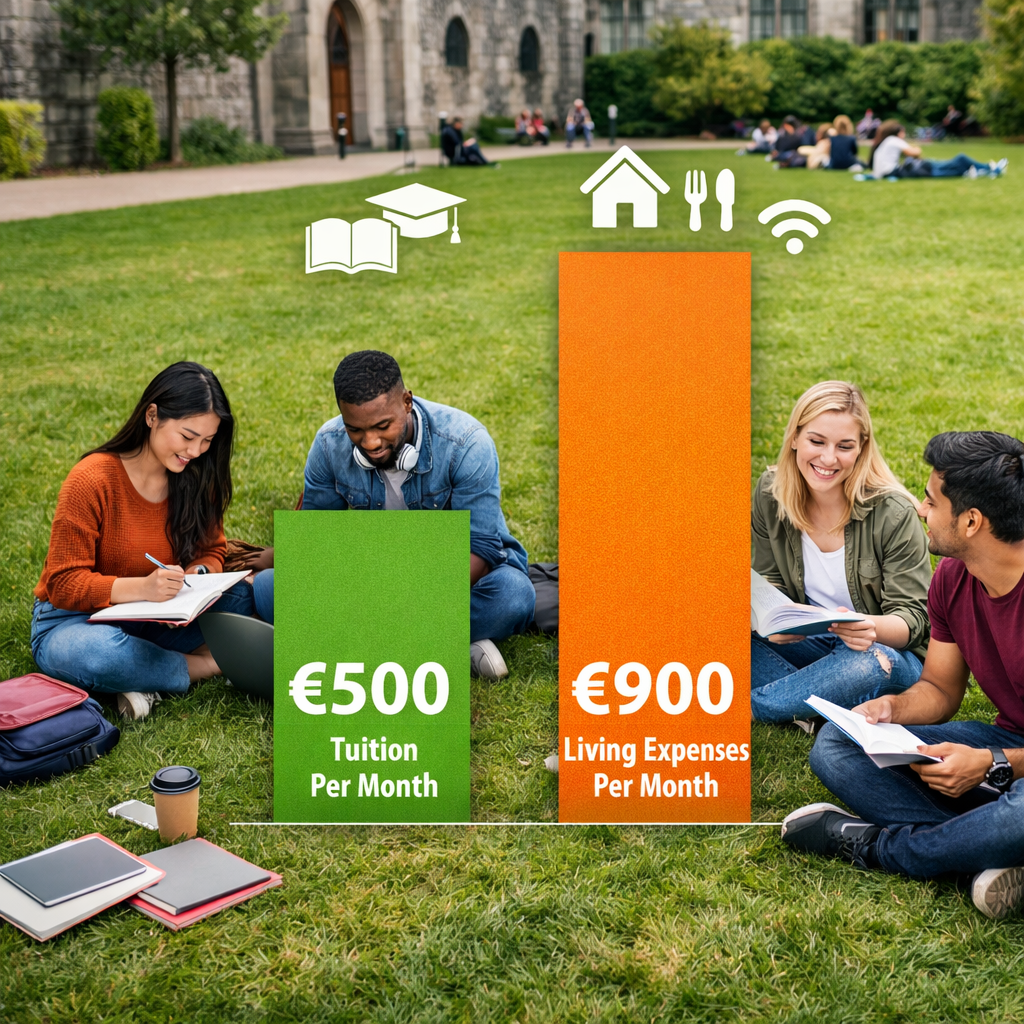
Location heavily shapes the Ireland student budget. Dublin is pricier mainly on rent and transport, while smaller cities can save several hundred euros per month. In-person weekly rates vary by city and season; outside Dublin, value schools are often under €300/week.
Indicative monthly planning ranges (tuition depends on provider and format):
- Tuition (in-person IELTS prep): €900–€1,200
- Accommodation: €600–€1,000
- Living costs (food/transport/misc): €800–€1,200
- IELTS exam fee Ireland: ~€220
- TIE exam (where applicable): ~€120
Verify materials fees, promotions, and exam-center availability early, especially around peak intakes.
ROI-first decision checklist
- Target band and current baseline by skill (L/R/W/S).
- Format fit: self-paced vs hybrid vs in-person; how much graded feedback do you need?
- Real monthly tuition (per method above) plus materials and exam fees.
- City costs (rent/transport) and commute time to Dublin language schools or regional centers.
- Time-to-recoup: weigh tuition against months saved to meet admission/visa/job deadlines.
Quick comparison (examples)
| Provider | Access length | Feedback level | Monthly-equivalent (est.) | Ideal learner |
|---|---|---|---|---|
| British Council/FutureLearn | 4–8 weeks (repeatable) | Low | €0–€30 | Self-starter, already B1+/B2 |
| Magoosh | 1–6 months | Light (Q&A) | ~$22–$109 | Independent, analytics-motivated |
| E2Language | 1–12 months | Medium–High | ~$28–$59+ | Needs marked writing/speaking to reach 7.0 |
| Kaplan (in-person) | Weekly blocks | High | €600+/month | Classroom accountability, structured path |
| IELTS Advantage | Cohort/ongoing | Very High (1:1) | Premium | Rapid Band 7+ with writing/speaking gaps |
Frequently asked questions
What is a realistic monthly budget in Dublin versus smaller cities?
Expect roughly €2,300–€3,400/month in Dublin including tuition, accommodation, and living; smaller cities can be several hundred euros less due to cheaper housing and transport.
Are exam fees included in course prices and how much is IELTS in Ireland?
Exam fees are usually separate; budget around €220 for IELTS and about €120 for the TIE exam if it’s required for your visa pathway.
How can I reduce monthly tuition without sacrificing speaking practice?
Use a low-cost self-paced course and add one affordable marketplace tutor session weekly; Skill Path Navigator’s comparisons help you choose and sequence options.
Do longer packages actually lower monthly cost?
Yes—multi-month access spreads fees over time and drops the monthly equivalent; Skill Path Navigator’s real monthly cost method makes the difference easy to see, especially with longer tiers or fast-finished subscriptions.
What documents and timing should non-EEA students plan for?
Prepare enrollment proof and financial statements, book your English exam early, and allow extra time for visa processing and exam seat availability.