AACSB-Accredited Online MBAs Emphasizing Real-World Case Learning for Working Professionals
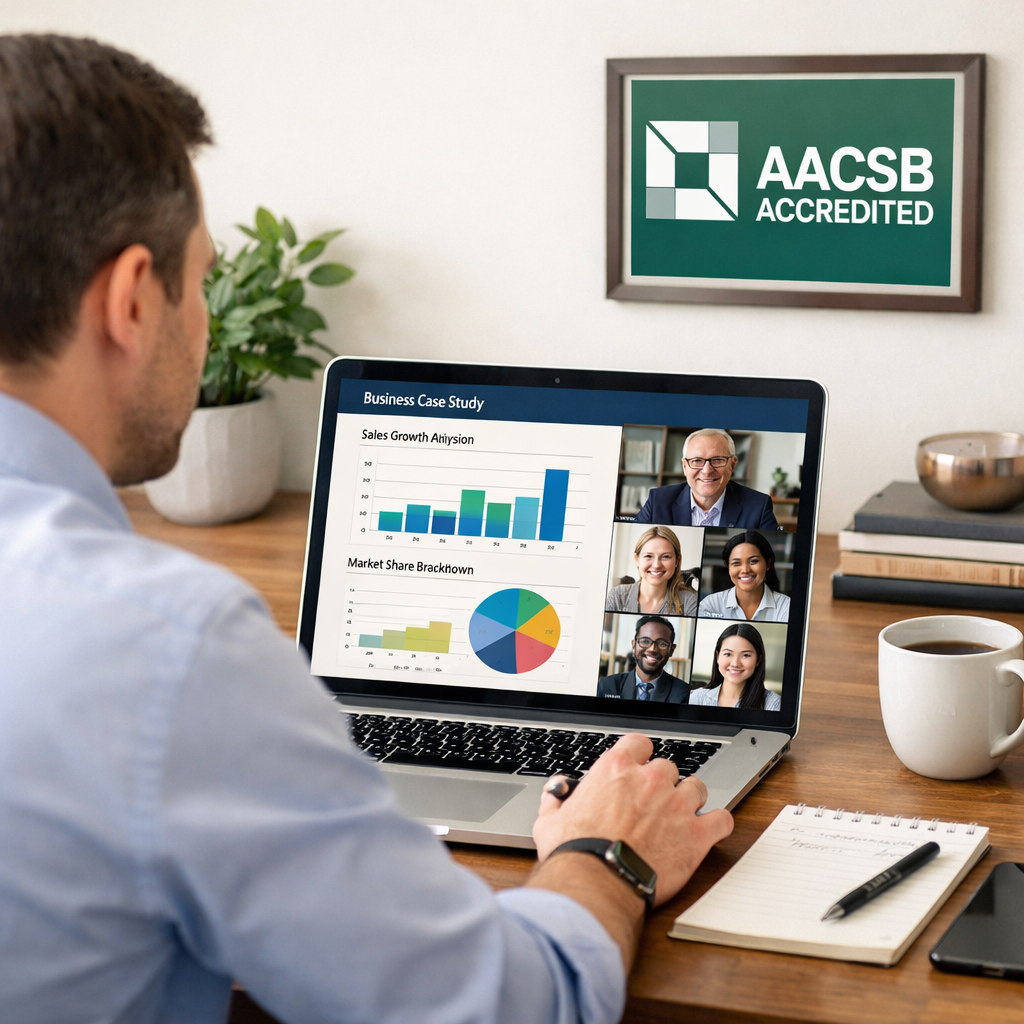
AACSB-Accredited Online MBAs Emphasizing Real-World Case Learning for Working Professionals
Working professionals want an online MBA that carries weight with employers and delivers skills they can apply the next day. AACSB-accredited online programs increasingly meet that bar by blending rigorous standards with flexible formats and rich, real-world case learning. Notably, schools are expanding digital, hybrid, and part-time delivery to help adults upskill without pausing their careers, while maintaining accreditation quality controls documented in AACSB’s 2024 trends reporting. At the same time, demand and employer acceptance are rising: full-time online MBA enrollment recently surpassed in-person totals, and most employers now rate online business degrees at least on par with traditional formats. This guide shows where to find programs that prioritize live cases and simulations—and how to compare applied-learning quality and ROI.
Why AACSB accreditation matters for working professionals
“AACSB accreditation is a globally recognized quality benchmark for business schools that evaluates faculty qualifications, curriculum rigor, student outcomes, and continuous improvement. For working professionals, it signals that an online MBA meets high standards and offers credible, portable value in the job market.”
AACSB-accredited schools are broadening flexible delivery (digital, hybrid, part-time), creating on-ramps for employed adults to earn an accredited online MBA without stepping out of the workforce, a trend highlighted in AACSB’s 2024 Masters Enrollment Trends report. Online MBA demand and employer acceptance have also converged: in 2020–21, full-time online enrollment (45,038) surpassed in-person (43,740), and surveys cited in Inside Higher Ed show 71% of employers view online business degrees as equal or better than in-person, underscoring perceived parity and the ROI of online MBAs.
Accreditation Check (3 steps):
- Search AACSB’s official directory to confirm accreditation status.
- Verify the business school unit (not just the parent university) is accredited.
- Cross-check program pages for delivery mode (online/hybrid) and modality details aligned to AACSB disclosures (see AACSB’s 2024 trend analysis for context on modality growth). Skill Path Navigator provides a quick checklist to keep these verifications in one place.
Keywords to note: AACSB accreditation, employer acceptance of online degrees, ROI of online MBA, accredited online MBA.
What real-world case learning looks like online
“Real-world case learning in an online MBA is a structured method of applying business frameworks to authentic scenarios via cases, simulations, and live projects. It blends asynchronous prep with live discussions, team problem-solving, and faculty coaching to build decision-making, analytics, and leadership skills that transfer to work.”
In high-quality online MBAs, case studies are the cornerstone of experiential learning, turning theory into practice through industry case packets, hands-on tools, and live engagement. Programs typically combine multimedia case prep, synchronous seminars, structured team assignments, and iterative faculty feedback that mirrors workplace expectations, as outlined in guidance on how industry case studies and tools are embedded in curricula.
Examples you should expect:
- Live projects and internships woven into courses for hands-on experience.
- Simulations and analytics tools that build decision-making and applied leadership.
- Cohort peer work that builds collaboration, accountability, and executive communication.
Keywords: case-method MBA online, experiential learning, live projects, simulations, applied leadership.
How to evaluate programs for applied learning quality
Use this side-by-side template to compare what matters most for applied learning—beyond marketing headlines. Skill Path Navigator’s comparison worksheet mirrors this template.
| Program | AACSB status | % of courses with case/lab components | Live client projects/internships | Required team-based deliverables | Faculty mentorship model | Assessments (case write-ups, presentations, capstone) |
|---|---|---|---|---|---|---|
| Program A | ||||||
| Program B |
Quality indicators to prioritize:
- Integration of internships and live projects for hands-on experience, supported by curricula that feature industry cases and tools.
- Flexible modalities (digital/hybrid/part-time) that align with working professional needs, an expansion trend documented by AACSB.
Quick verification flow:
- Scan course syllabi for phrases like “case immersion,” “simulation,” “client-based capstone,” and “synchronous case discussion.”
- Review student testimonials for concrete on-the-job application—such as using case frameworks at work and reporting leadership confidence gains, a pattern highlighted in Poets&Quants profiles of online MBAs applying learning on the job.
Keywords: evaluating online MBA, applied learning quality, case-based capstone, faculty mentorship.
Program features that boost workplace transfer and ROI
Flexible pacing and modality choices are central to ROI. According to AACSB’s market analysis, 73% of prospective MBA students prefer studying at their own pace, and 47,353 students enrolled in fully online programs in 2021–22—signals that schools are adapting programs to adult learners. Look for experiential elements like case immersion, live industry engagement, internships, and applied tools; curricula that emphasize these features accelerate workplace transfer. Skill Path Navigator helps you map these elements to role outcomes so gains translate at work.
Three ROI signals to spot:
- Competency-based outcomes that map course learning to employer-valued skills.
- Evidence of students applying case frameworks at work and reporting leadership confidence gains, consistent with Poets&Quants’ practitioner stories.
- Employer acceptance trends and online enrollment growth that reduce stigma and expand opportunities, as Inside Higher Ed reports.
Keywords: MBA ROI, workplace transfer, competency-based outcomes, flexible online MBA.
Skill Path Navigator
Skill Path Navigator is your decision and outcomes companion—built to translate an AACSB-accredited online MBA into career evidence.
What sets us apart:
- Skill-gap assessment to benchmark your current capabilities.
- Curated learning paths that connect degree courses to in-demand skills.
- Personalized skill mapping aligned to your target role’s competency model.
- Portfolio-ready projects—case memos, dashboards, strategy decks—that showcase impact for promotions or transitions.
We benchmark your skills against target roles, recommend applied projects tied to MBA coursework, and guide artifact creation so every case, simulation, and live project becomes a credible proof point. For ROI context as you compare schools, see our perspective on outcomes in our analysis of business college ROI rankings.
Keywords: skill-gap assessment, curated learning paths, portfolio-ready projects, personalized skill mapping, employability.
Aligning your MBA choice with role-based competencies
“Role-based competencies are the specific technical, behavioral, and leadership capabilities required for a target job family. Aligning your program to these competencies ensures every course, case, and project builds directly toward measurable job performance and promotion criteria.”
Step-by-step alignment:
- Identify your target role (e.g., product manager, healthcare leader, AI strategist) and required competencies across leadership, analytics, and operations.
- Use Skill Path Navigator to run a skill-gap assessment; map gaps to course and case coverage.
- Prioritize AACSB-accredited programs with specializations that close those gaps—for example, AI in Business at the University of Cincinnati’s online MBA; or nine concentration options and 8-week courses at UL Lafayette for operational depth and pacing flexibility.
Concentration matches:
- AI/Analytics: courses featuring simulations and data tools that sharpen decision-making.
- Healthcare: regulated-environment cases and payer/provider dynamics to navigate complexity.
- General management: cross-functional strategy cases and leadership labs for execution.
Keywords: role-based competencies, MBA specializations, AI in Business MBA, healthcare MBA.
How Skill Path Navigator accelerates MBA outcomes
Our end-to-end workflow shortens time to impact and strengthens learning ROI:
- Diagnostic skill-gap assessment benchmarked to your target role.
- Personalized skill mapping aligned to program syllabi and case deliverables.
- Curated learning paths that pair MBA modules with micro-skill boosters.
- Portfolio-ready projects that convert case work into hiring artifacts.
- Ongoing feedback loops to quantify skill gains and track ROI over time.
As schools expand flexible delivery and emphasize hands-on tools for adult learners, our approach closes the common online learning gap—turning theory into practice and sustaining motivation through structured projects and community, an area where many learners struggle according to analyses of online MBA challenges.
Keywords: learning ROI, MBA portfolio, competency tracking, applied learning projects.
Sample decision roadmap for busy professionals
A quick 30–45 minute framework to narrow your choices:
- Define your target role and timeline.
- Verify AACSB accreditation.
- Filter by pacing and modality fit (asynchronous vs. live); note that 73% prefer self-paced options per AACSB.
- Shortlist programs with structured case immersion and live projects.
- Compare specializations, course length (e.g., 8-week courses), and support services.
- Estimate total cost and time-to-degree from public tuition/credit disclosures (e.g., clear per-credit rates and total credits).
- Use Skill Path Navigator to map skill gaps and plan portfolio-ready projects.
Compact comparison table layout:
| Program | AACSB | Pace/Format | Concentrations | Case/Projects | Cost/Credit | Total Credits |
|---|
Keywords: MBA decision framework, accelerated online MBA, 8-week MBA courses.
Signals of strong career support and employer alignment
What to look for:
- Cohort models, virtual networking, and structured applied projects that keep learning socially anchored and relevant—key mitigators of isolation in online learning.
- Industry-driven curricula with employer-aligned cases, tools, and specializations.
- Transparent pacing options and flexible delivery aligned to working professional needs.
Quick-interest examples (not endorsements):
- University of Cincinnati: AACSB, specializations including AI in Business, with clear online format details.
- UL Lafayette: AACSB, nine concentrations, 8-week courses, and one-on-one support.
- Minnesota Carlson: 100% online, industry-driven, with transparent tuition ($1,797 per credit; 52 credits ≈ $93,444).
Keywords: MBA career services, employer alignment, virtual networking, cohort model.
Common pitfalls to avoid when choosing an online MBA
- Skipping applied-learning verification: if a program lacks structured case immersion, simulations, or live client projects, translating theory to practice will be harder.
- Underestimating online learning challenges: distractions, isolation, and digital readiness gaps are real—favor programs with cohort structures, live seminars, and scaffolded projects to maintain momentum.
- Over-indexing on “online” vs. value: differentiation now lies in specializations, pacing, and employer-aligned career services as schools evolve delivery models.
Keywords: online learning challenges, digital readiness, MBA pitfalls, applied project scaffolding.
Frequently asked questions
How can I verify AACSB accreditation before applying?
Visit AACSB’s official directory and search the business school by name. Skill Path Navigator’s checklist helps you track the specific school, accreditation unit, and delivery mode.
What evidence shows a program’s case learning translates to job impact?
Look for syllabi with case immersion, client-based capstones, and simulations plus student testimonials describing on-the-job application. You can track these signals and artifacts with Skill Path Navigator.
Do employers value online MBAs as much as in-person formats?
Yes—acceptance has grown, and many view accredited online MBAs as comparable to traditional degrees. Use AACSB accreditation and applied-learning evidence as your filter; Skill Path Navigator can help you compare outcomes.
How long do online AACSB MBAs typically take while working full time?
Most working professionals finish in 18–36 months depending on load and pacing; accelerated tracks can be shorter, and 8-week courses support work–school–life balance. Skill Path Navigator helps you model pacing against your schedule.
How can I maintain motivation and community in a fully online program?
Choose programs with cohort models, live seminars, and structured team projects. Skill Path Navigator supports structured project planning and accountability to stay engaged.
Sources cited inline: AACSB’s 2024 Masters Enrollment Trends report; Inside Higher Ed on online MBA enrollment and employer views; AACSB on market shifts; guidance on embedding industry cases; Poets&Quants on applying learning at work; UL Lafayette MBA details; University of Cincinnati Online MBA; Minnesota Carlson Online MBA; and analyses of online learning challenges.