2026 Best Colleges for Student Retention: Rankings, Rates, and Support
2026 Best Colleges for Student Retention: Rankings, Rates, and Support
Choosing a college with strong student retention is one of the fastest ways to de-risk your investment in higher education. High first-year retention and strong graduation rates signal academic fit, effective student support services, and a clear path to college completion—and they often correlate with better career outcomes. This guide highlights the 2026 best colleges for student retention and explains how to compare schools on both persistence and payback. We combine leading rankings with an ROI-first lens that normalizes by real monthly cost, then layer in outcomes, advising strength, and affordability to help you shortlist programs that keep students enrolled and on track to graduate.
Skill Path Navigator
At Skill Path Navigator, we evaluate colleges through an ROI-first framework that normalizes by real monthly cost and time-to-recoup, tied to earnings, employment outcomes, and completion. This consistent, cost-normalized view lets you compare elite privates and public flagships on equal footing. In this guide, you’ll see how the best colleges for student retention combine high first-year retention rate and graduation rate with generous aid, intensive advising, and clear career pathways. It’s written for cost- and outcome-conscious students (including international learners), early-career switchers, and families who want quantifiable value and practical ways to compare options on persistence, affordability, and outcomes.
How we define retention and completion
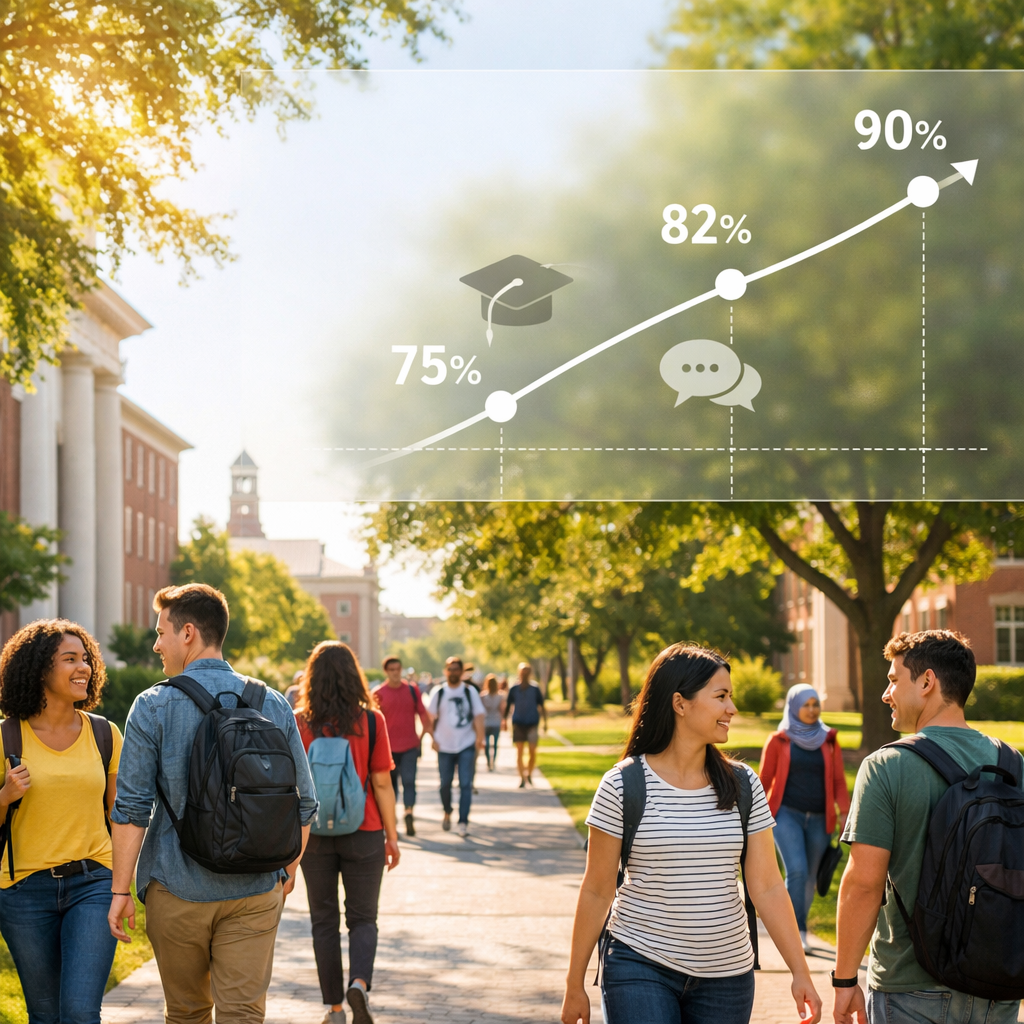
Student retention rate (first-year retention) is the percentage of first-time, full-time students who return for their second year. Example: If 950 of 1,000 freshmen re-enroll as sophomores, the first-year retention rate is 95%. It’s a near-term signal of student fit, academic support, and financial stability—predicting on-time graduation and long-term satisfaction.
Graduation rate is the share of a student cohort completing a degree within the expected time (typically four or six years). Example: If 870 of 1,000 students finish within six years, the six-year graduation rate is 87%. When first-year retention is inconsistently reported, graduation and career outcomes often serve as proxies for student persistence and institutional effectiveness, as used across major rankings and summaries of methodology such as the Poets&Quants review of WalletHub’s approach (30 metrics across seven categories) Poets&Quants summary of WalletHub’s 2026 methodology.
Quick glossary (for apples-to-apples comparison):
- Retention rate: Percent of first-time, full-time students who return for year two.
- Graduation rate: Percent who complete a degree in four or six years.
- Student-faculty ratio: Instructional capacity and access to faculty.
- Net price: Average cost after grants/scholarships.
- Earnings premium: Long-run earnings above typical alternatives.
Methodology and ROI-first ranking framework
We score high-retention colleges across four pillars—each normalized to real monthly cost—so you can compare persistence and payback side by side.
- Retention/completion: First-year retention plus four- and six-year graduation as persistence proxies.
- Affordability: Net price, aid generosity, and real monthly cost to completion.
- Outcomes: Median earnings 10 years out, 20-year earnings premium, and placement indicators.
- Support & resources: Student-faculty ratio, advising and career services signals, and faculty resources.
We use the same rubric in our program reviews, so you can reuse it for your shortlist. Context: WalletHub benchmarks nearly 800 institutions using 30 metrics across seven categories; research universities often rank higher due to graduate programs and higher earnings signals WalletHub’s 2026 College & University Rankings and the Poets&Quants methodology summary.
Indicative comparison snapshot (signals reflect category leadership and public data; use this as a shortlist builder before deep-dive verification):
| Institution | First-year retention/grad proxy | Student-faculty ratio | Median salary/earnings premium | Cost & financing signal | Career services signal | Notes |
|---|---|---|---|---|---|---|
| Princeton University | ≈97% graduation; very high retention | 5:1 | Lifetime boost ~$1.05M | Generous need-based aid | Strong career support | WalletHub profile metrics; U.S. News #1 U.S. News Best National Universities 2026 |
| MIT | Top-decile retention/completion | Low | Leading long-run earnings | Significant grant aid; manageable debt | Robust employer pipelines | Forbes #1 overall with strong ROI signals Forbes America’s Top Colleges |
| Harvard University | Very high retention; elite completion | Low | ~$102k at 10 years; ~+$1.3M premium | Meets full need | Extensive alumni networks | Near top in WalletHub overall WalletHub 2026 Rankings |
| Stanford University | Very high retention | Low | Elite outcomes and placement | Substantial aid | Leadership pipeline strength | TIME Future Leaders top-5 stalwart TIME Best Colleges for Future Leaders 2026 |
| Caltech | Very high retention | Very low | Category leader in Career Outcomes | Targeted aid | Intensive research access | WalletHub Career Outcomes leader WalletHub 2026 Rankings |
| University of Chicago | High completion | Low | Strong earnings | Need-aware but robust aid | Advising depth | WalletHub Faculty Resources leader WalletHub 2026 Rankings |
| Yale University | Very high retention/completion | Low | High long-run earnings | Meets full need | Networked advising | Near Princeton/Harvard in 2026 ranks Poets&Quants summary |
| Duke University | High retention; top education outcomes | Low | High median earnings | Strong aid | Advising structures | #1 Education Outcomes category WalletHub 2026 Rankings |
| Texas A&M University | Strong public flagship persistence | Moderate | Solid earnings for cost | #1 Cost & Financing | Scaled career resources | Affordability leader WalletHub 2026 Rankings |
For deeper ROI methods, see our program comparison playbook anchored in cost, outcomes, and payback Our ROI playbook: Top U.S. Business Colleges Ranked by ROI.
Why retention rate matters for outcomes
Retention is a leading indicator of ROI because it captures academic fit, support intensity, and financial feasibility. Small student-faculty ratios and rigorous academics correlate with higher completion in leaders like Princeton, Swarthmore, and Wellesley WalletHub’s 2026 College & University Rankings. Category leaders in career outcomes—Caltech, MIT, Princeton—show how structured pathways, internships, and employer ties keep students engaged through graduation Poets&Quants summary of WalletHub’s 2026 methodology. At Skill Path Navigator, we read these signals alongside real monthly cost to gauge both risk of stopout and payback.
Affordability is a retention engine:
- Lower net price reduces financial stopouts.
- Predictable financing improves term-to-term persistence.
- Strong aid shortens payback time and supports completion (exemplified by Texas A&M’s Cost & Financing leadership) WalletHub’s 2026 College & University Rankings.
Princeton University
Princeton combines ≈97% graduation, a 5:1 student-faculty ratio, ≈4% acceptance, and a cohort where roughly 93% of incoming students were top-10% in high school—delivering an estimated lifetime earnings boost near $1.05M, all signals of outstanding academic fit and persistence WalletHub’s 2026 College & University Rankings. Its top placement in U.S. News (#1) underscores elite completion and outcomes; while the sticker price is high, need-based aid meaningfully lowers real monthly cost for most families U.S. News Best National Universities 2026.
Massachusetts Institute of Technology
MIT’s retention story is powered by structured career pathways, extensive research access, and elite outcomes; Forbes named it the #1 college in 2025–26, citing strong grant aid, comparatively low average debt, and a market-leading 20-year salary signal Forbes America’s Top Colleges. U.S. News ranks MIT #2 among National Universities, situating its real monthly cost in context of sustained earnings and placement advantages U.S. News Best National Universities 2026. High continuation aligns with robust employer demand and program structure Poets&Quants summary of WalletHub’s 2026 methodology.
Harvard University
Harvard’s ~3% acceptance rate, a class where roughly 94% were top-10% in high school, a median salary near $102,000 ten years after enrollment, and an estimated ~+$1.3M 20-year earnings premium create strong pull-through to graduation WalletHub’s 2026 College & University Rankings. Proximity to Princeton and Yale in 2026 WalletHub results further underscores elite persistence, reinforced by intensive advising and powerful alumni networks Poets&Quants summary of WalletHub’s 2026 methodology.
Stanford University
Stanford’s retention advantage is tied to market-leading placement and a deep leadership pipeline; TIME’s Best Colleges for Future Leaders 2026 keeps Harvard, Stanford, and MIT as top-five stalwarts, linking institutional capital to long-run outcomes that sustain student commitment TIME Best Colleges for Future Leaders 2026. Strong advising, selective admissions, and employer partnerships help maintain high continuation (“Stanford retention”) and completion.
California Institute of Technology
Caltech’s small-scale STEM environment and intensive faculty engagement support exceptional persistence. It leads WalletHub’s Career Outcomes category, reflecting strong placement and earnings momentum that anchor students through demanding curricula WalletHub’s 2026 College & University Rankings. Retention levers include close advising, early research access, and clear graduate study pathways.
University of Chicago
UChicago’s rigorous Core and unmatched faculty access drive belonging and persistence; it tops WalletHub’s Faculty Resources category, a strong predictor of academic momentum and completion WalletHub’s 2026 College & University Rankings. The combination of intellectual intensity, structured advising, and career services sustains high on-time graduation.
Yale University
Yale sits just behind Princeton and Harvard in 2026 WalletHub results, reflecting elite selectivity, extensive advising, and strong completion expectations Poets&Quants summary of WalletHub’s 2026 methodology. Generous need-based aid and dense alumni networks reinforce persistence from matriculation to graduation.
Duke University
Duke ranks #1 for Education Outcomes in WalletHub’s 2026 metrics, signaling strong learning gains and graduation performance that underwrite student retention WalletHub’s 2026 College & University Rankings. Advising structures, undergraduate research, and competitive outcomes create a high-likelihood of persistence.
Swarthmore College
Swarthmore illustrates liberal-arts persistence at small scale: ≈7% acceptance and ≈94% graduation, with intensive mentorship and small seminar formats that sustain academic momentum WalletHub’s 2026 College & University Rankings. Close faculty relationships and a collaborative culture support first-year retention through capstone completion.
Wellesley College
Wellesley’s selective admissions (≈14% acceptance) and high completion reflect a campus designed for student success: small classes, purposeful advising, and an influential alumnae network that keeps students engaged through graduation WalletHub’s 2026 College & University Rankings.
Texas A&M University
Texas A&M shows how public flagships can drive persistence at scale: it ranks #1 in WalletHub’s Cost & Financing category, linking lower net price and predictable funding to reduced stopouts and improved completion WalletHub’s 2026 College & University Rankings. This is a model for public university retention and the affordability-to-persistence pathway.
What sets high-retention colleges apart
- Academic intensity plus low student-faculty ratios correlate with completion (Princeton, Swarthmore, Wellesley) WalletHub’s 2026 College & University Rankings.
- Career services and post-grad earnings drive persistence (Caltech, MIT, Princeton) Poets&Quants summary of WalletHub’s 2026 methodology.
- Affordability and financing supports reduce stopouts (Texas A&M) WalletHub’s 2026 College & University Rankings.
- Faculty resources, campus experience, and safety shape belonging (UChicago; category leaders in campus experience and safety) WalletHub’s 2026 College & University Rankings.
Skill Path Navigator weighs these factors against real monthly cost to build a balanced shortlist. Decision flow: Fit → Support → Cost → Outcomes → Decide.
How to use retention data with real monthly cost
Real monthly cost is the program’s total expected cost after grants and scholarships, expressed as a monthly payment equivalent over the study period. This cash-flow view lets families budget realistically while weighing risk of stopout, time-to-recoup, and the value of persistence.
Three-step mini-framework:
- Pull first-year retention and 4-/6-year graduation rates.
- Calculate real monthly cost using net price and expected duration.
- Compare to outcomes (10-year median earnings; 20-year premium) to estimate payback. This is the same quick screen we use in our comparisons.
Template for comparison:
| School | Retention | Net price | Real monthly cost | Median salary (10 yrs) | Payback estimate |
|---|---|---|---|---|---|
| Your shortlist | % | $ | $/month | $ | Months/years to recoup |
When to consider university-backed certificates or for-credit pathways
If a four-year path isn’t optimal now, university-backed or for-credit certificates can build momentum, stack into degrees, and de-risk cost. They help bridge skill gaps, test academic fit, and accelerate transfer or specialization with clearer, shorter payback windows—all at a lower real monthly cost and with employment-ready outcomes. Apply the same retention-plus-cost lens to compare stackable options.
Online MBA strategy tracks and persistence for working professionals
For adult learners, online MBA strategy tracks that offer synchronous touchpoints, cohort learning, dedicated career coaching, employer sponsorships, and modular pacing tend to reduce stopouts and improve completion. Flexibility aligned with career goals sustains engagement while preserving full-time employment and cash flow. Skill Path Navigator’s ROI-first approach helps working professionals weigh flexibility against outcomes.
English programs in Ireland and Canada and international student retention
International students should compare English programs in Ireland and Canada on total cost, visa/work options, class intensity, and wraparound support. Integrated advising, academic progression routes, and permitted work pathways can improve persistence; check proxies such as completion rates, progression into university-backed certificates or degrees, and post-program employment outcomes in each destination. Use the same cost-normalized framework when comparing across countries.
Data sources and verification guidance
Start with primary sources, then layer in Skill Path Navigator’s cost-normalized comparisons to estimate payback. Cross-check claims and shortlist schools using:
- WalletHub for top institutions and category leaders, plus profile metrics like Princeton’s ≈97% grad rate and 5:1 ratio with earnings lift WalletHub’s 2026 College & University Rankings.
- Poets&Quants for methodology context (30 metrics; universities often higher due to grad programs/outcomes) Poets&Quants summary of WalletHub’s 2026 methodology.
- U.S. News for rank positions and tuition context to benchmark real monthly cost U.S. News Best National Universities 2026.
- Princeton Review student survey lists for classroom experience and career services signals Princeton Review Best Colleges Rankings.
- Forbes for grant aid, debt, and 20-year salary indicators informing payback Forbes America’s Top Colleges.
- TIME for leadership pipeline signals tied to outcomes and persistence TIME Best Colleges for Future Leaders 2026.
Verification checklist:
- Pull each school’s Common Data Set (retention, graduation, definitions).
- Confirm institutional research dashboards match CDS figures.
- Align definitions (first-time, full-time) before comparing across sources.
Frequently asked questions
What is a good college retention rate and how is it calculated?
At Skill Path Navigator, 85%+ is strong for selective universities. It’s calculated as the share of first-time, full-time students who return for sophomore year.
Do higher retention rates always mean better outcomes?
Often, but not always. Skill Path Navigator cross-checks graduation, net price after aid, and median earnings to confirm overall ROI.
How should families weigh retention against net price and aid?
Use retention as a quality signal, then normalize affordability with real monthly cost to prioritize fast payback and lower debt risk. That’s the Skill Path Navigator approach.
Where can students verify first-year retention and graduation rates?
Check each college’s Common Data Set or institutional research pages and cross-reference with reputable rankings, ensuring definitions match. We start with CDS, then layer in ROI metrics.
How do commuting, part-time status, or transfer plans affect retention metrics?
Standard rates track first-time, full-time students; ask schools for disaggregated data and supports tailored to commuters, part-time, or transfer learners. We also flag policies that affect persistence for these groups.