10 Enrollment Funnel Optimization Tactics That Lift Application Conversions
10 Enrollment Funnel Optimization Tactics That Lift Application Conversions
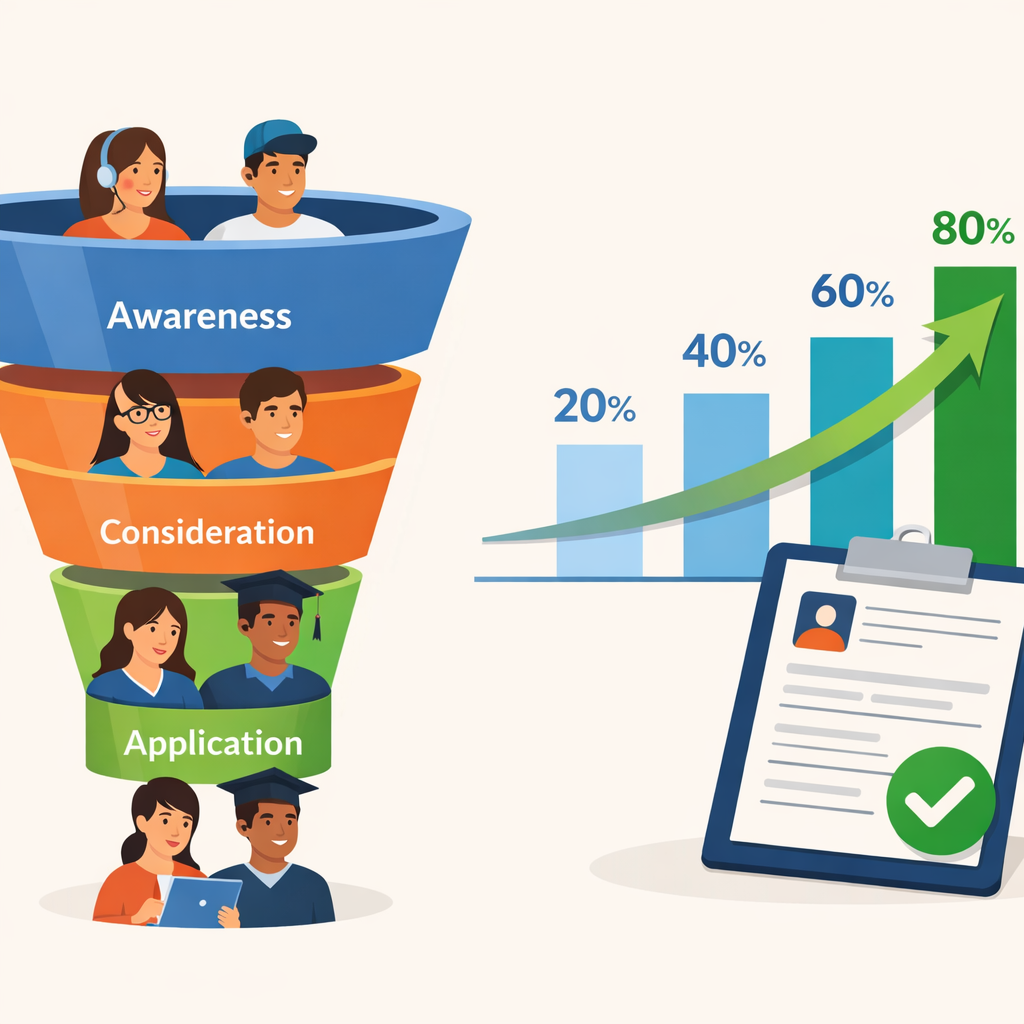
A higher education enrollment funnel maps how prospects move from awareness to application and enrollment, commonly framed as TOFU, MOFU, and BOFU—top, middle, and bottom of the funnel aligned to awareness, consideration, and decision. This guide distills 10 actionable tactics that reduce friction, sharpen targeting, and raise application conversions while safeguarding equity and compliance. Drawing on research-backed practices—and Skill Path Navigator’s ROI-first lens—you’ll learn how to simplify forms, clarify deadlines, deploy direct-admit and “claim your spot” flows, personalize aid, blend CRM automation with human touch, re-engage with programmatic ads, surface outcomes fast, apply predictive analytics, scale SEO, and measure what matters. When these tactics work in concert, institutions see faster time-to-apply, higher completion rates, stronger yield, and less melt—validated by leading enrollment strategy frameworks and case evidence from industry analyses.
Skill Path Navigator
Skill Path Navigator approaches enrollment funnel optimization through a research-driven, ROI-first lens. We prioritize accredited and visa-ready programs across business, finance, analytics, fintech, and language pathways, and we equip both learners and institutional teams with tools that drive confident, timely decisions. Our program shortlists, ROI rankings, and admissions/visa checklists help students compare options by outcomes and readiness; our institutional playbooks cover yield strategy and segmentation, admit-to-deposit modeling, and deposit melt risk management. For teams ready to operationalize these tactics, our frameworks emphasize clear definitions, measurable KPIs, and ethical experimentation so you can prove lift—not just activity. Learn more about our approach at Skill Path Navigator.
Clear deadline and requirement messaging
When deadlines and requirements are unmistakable, applicants make fewer errors and complete more steps on time. Clear, multi-channel reminders reduce confusion and lower melt, as emphasized in enrollment funnel best practices from Enrollify’s analysis of admissions communications. Application melt is the drop-off from admitted to enrolled students caused by missed steps, unclear next actions, or competing commitments; timely, personalized reminders measurably reduce melt.
Make urgency explicit, then validate with testing. Subject lines and banners like “Final deadline approaching” or “I-20 cutoff next week” paired with countdown timers can raise response rates; A/B test urgency phrasing, send times, and channel mix to quantify lift, a tactic frequently recommended in performance-focused enrollment playbooks.
International applicants need additional specificity: visa and I-20 timelines, embassy appointment lead times, and CEA/ACCET notes for English programs should be showcased early to ensure immigration readiness. Skill Path Navigator’s admissions and visa checklists map these milestones and standardize reminders across channels.
Sample timeline map your team can adapt:
| Milestone | Required documents | Reminder channels | Final date |
|---|---|---|---|
| Priority application | Transcript, test optional form, resume | Email, SMS, counselor call | Jan 15 |
| FAFSA/aid priority | FAFSA, tax docs, scholarship essays | Email, student portal banners | Mar 1 |
| Deposit | Deposit payment, housing preference | SMS, portal task, phone call | May 1 |
| I-20/visa (intl) | Financial proof, passport, SEVIS fee | Email, WhatsApp, webinar | Jun 15 |
Simplified mobile-first application forms
Short, mobile-first forms with progressive disclosure dramatically cut abandonment. Progressive disclosure is a UX approach that reveals only the necessary fields at each step, reducing cognitive load and completion time—especially on phones. Start by collapsing nonessential fields, enabling autofill, and sequencing questions from easiest to hardest. Replace long essays with structured prompts that assess fit in less time. Offer document uploads via cloud links, include save-and-return, and provide a live status tracker so applicants know exactly what’s left.
Run A/B tests on field counts, layout, and labeling, and track application completion rate and time-to-apply to identify the shortest frictionless path. Modern Campus benchmarks underscore that trimming steps and clarifying progress meaningfully improves funnel throughput. Skill Path Navigator provides mobile-first form checklists and prompt libraries to speed implementation.
Direct-admit and claim your spot flows
Direct admissions offers admission based on known criteria—such as GPA—without requiring a full application, then prompts students to confirm their seat via a short form. Reported cases show direct admissions can boost overall enrollment by roughly 176%, with a 177% increase among underrepresented minority enrollments, illustrating its potential to expand access while lifting counts.
A “claim your spot” flow typically includes:
- Pre-qualification using transparent criteria (e.g., GPA, completed prerequisites)
- Instant decision notification with clear next steps
- A 3–5 field confirmation form that collects intent, program selection, and contact details
- Deposit and onboarding bundle (aid consult booking, document checklist, orientation sign-up)
Protect equity and compliance with published criteria, an appeals process, and tailored guidance for first-generation and low-income cohorts to ensure that speed does not come at the cost of fairness. Skill Path Navigator’s direct-admit templates include criteria documentation and appeals workflows to operationalize this at speed and with fairness.
Personalized financial aid guidance
Cost clarity is the fastest way to reduce anxiety and move students from interest to application. In EAB’s research on adult learners, cost of attending ranked highest in importance and was rated 4.37 out of 5, reinforcing the need to address price early. Net price is the estimated total cost of attendance after grants and scholarships; surfacing it upfront reduces uncertainty and supports faster decisions.
Prioritize:
- Net price calculators keyed to program modality and residency
- Scholarship landing pages with filters by eligibility and deadlines
- Aid timelines with FAFSA milestones and document lists
- One-on-one counselor sessions and live workshops to answer individual questions
- International funding guidance and proof-of-funds checklists aligned to visa requirements
- ROI calculators that show time-to-recoup based on median salaries and placement rates
Follow-up calls or chats after aid workshops keep momentum, a practice associated with higher confidence and commitment in several funnel optimization guides. Skill Path Navigator’s ROI rankings pair naturally with net price calculators so students can weigh cost against likely outcomes early.
A/B testing and cohort analytics
Iterative testing reveals quick wins across copy, layout, and form design. Start with A/B tests on call-to-action text, page layout, and application variants; track changes in completion rate and time-to-apply to quantify impact, as performance marketers for student recruitment consistently recommend.
Use funnel tiers to tailor content by stage: TOFU, MOFU, and BOFU align to awareness, consideration, and decision, allowing you to present the right proof at the right time. Build cohort views to spot divergent behaviors:
- Domestic vs. international
- Program interest (finance, analytics, ESL)
- Device type (mobile vs. desktop)
- Counselor touch (contacted vs. not)
- Aid status (aid started vs. aid completed)
Segmenting by these dimensions clarifies where targeted fixes will produce the largest conversion lift. Skill Path Navigator’s frameworks include stage definitions, segmentation templates, and testing plans to make execution repeatable.
CRM-driven automation and human touch blend
An enrollment CRM is a system that integrates prospect interactions, applications, communications, and tasks to personalize messaging and orchestrate timely outreach. CRMs centralize data and reduce silos so counselors see a unified student record and can trigger relevant nudges, a core recommendation in Salesforce’s admissions funnel guide.
Yet automation alone isn’t enough. Nearly 30% of students report that post-enrollment communication made them feel less valued; time human follow-ups to reinforce support. Consider:
- Trigger-based emails and SMS tied to behaviors (form abandon, aid started, visit scheduled)
- Counselor routing for high-intent signals with same-day tasks
- Task queues synced to predictive scores and stage SLAs
- Conversation summaries logged back to the CRM to inform the next touch
Jenzabar’s guidance on using the enrollment funnel to evaluate strategies reinforces the value of centralized tracking and pipeline visibility to improve coordination and speed. Skill Path Navigator’s playbooks outline trigger maps and SLAs that align automation with timely counselor outreach.
Retargeting and programmatic ads
Retargeting and programmatic display re-engage high-intent prospects who viewed key pages or started applications but didn’t finish. Programmatic ads use audience data and real-time bidding to deliver targeted ads across channels to specific segments, allowing creative to match the last action taken.
Map creative to funnel stage:
- TOFU: Role-aligned benefits, campus life, stackable credentials
- MOFU: Curriculum highlights, accreditation, faculty, sample syllabi
- BOFU: Deadlines, scholarships, counselor booking, “submit now” prompts
Build audiences such as application starters without submit, scholarship page viewers, international checklist visitors, and program shortlist downloaders to increase relevance and reduce waste. Skill Path Navigator’s audience and creative mapping worksheets help teams align messages to each stage without guesswork.
Outcomes-focused proof and social proof
Prospects skim. EAB reports that many graduate program page visits last about 90 seconds, so lead with outcomes above the fold: employer partnerships, median salaries, placement rates, and time-to-recoup. Social proof—testimonials, alumni outcomes, and employer endorsements—signals credibility and reduces decision risk. Pair these elements with accreditation and visa-ready badges so international applicants immediately see institutional readiness.
Add a compact ROI module to primary program pages:
- Median salary and salary range
- Placement rate and internship pipelines
- Recruiter/employer partners
- Alumni network size and marquee titles
- Estimated time-to-recoup and net price context Skill Path Navigator favors outcomes-first page layouts and side-by-side comparisons so value is immediately clear.
Predictive analytics for prioritization
Predictive scoring helps focus counselor time where it matters most. In a study summarized in Salesforce’s admissions guide, an XGBoost model predicted application submission with a ROC of 99.7% and a gradient boosting model predicted enrollment with a ROC of 92.3%, with demographics and behaviors outperforming raw outreach volume as predictors. ROC (Receiver Operating Characteristic) is a performance curve plotting true positive rate against false positive rate; higher area under the curve indicates stronger predictive power.
For trust and adoption:
- Train with holdout sets, perform fairness checks by subgroup, and document variables
- Use explainable features and reason codes so counselors understand “why” a prospect is prioritized
- Operationalize: route top-decile scores to same-day outreach, trigger aid consults for price-sensitive leads, and politely suppress low-fit segments Skill Path Navigator prioritizes explainable features, fairness checks, and route-to-action playbooks so scores drive better outreach—not bias.
SEO and content strategy for sustained top-of-funnel growth
Strong SEO and content marketing compound organic visibility and reduce reliance on paid media over time. Search intent is the underlying goal of a query—informational, navigational, or transactional—and aligning pages to intent increases relevance and rankings. Map keywords by program and learner goal, build comparison pages for accredited and visa-ready programs, and publish scholarship hubs and international visa checklists to capture sustained TOFU demand.
Structure content by TOFU/MOFU/BOFU, deploy FAQ and HowTo schema where appropriate, and address role-aligned queries like “corporate finance vs. fintech ROI” with data-forward pages. Infinity Marketing’s guidance on college enrollment optimization underscores how intent-matched content and technical hygiene improve discoverability and engagement. Skill Path Navigator’s content blueprints emphasize accredited and visa-ready comparisons, scholarship hubs, and visa checklists to compound TOFU growth.
Measurement framework and ROI tracking
Typical US undergraduate admissions conversion rates average roughly 20%–50%, with many graduate programs higher due to more focused recruitment, according to admissions funnel overviews from Modern Campus. Build a measurement plan that tracks stage conversions and velocity, cost efficiency, and attribution so you can prioritize the highest-ROI tactics. Use full-funnel analytics to isolate drop-offs, compare channels on cost per lead and cost per enrolled student, and run quarterly audits with controlled experiments to evolve your playbook. Carnegie’s enrollment framework and Propellant’s performance tactics both emphasize disciplined, ongoing optimization. Skill Path Navigator’s scorecards tie conversion, velocity, and ROI to clear next actions and budget shifts.
Funnel conversion and velocity metrics
Track where prospects stall and how fast they move:
- Stage rates: inquiry to application, application to offer, offer to yield
- Velocity: time from inquiry to start, inquiry to application, and application to decision
- Benchmarks: undergraduate conversion often ranges 20%–50%; graduate programs may exceed that in focused markets
Quick-start flow:
- Define events and funnel stages
- Instrument tracking (forms, CRM, web analytics)
- Set targets per stage and cohort
- Build weekly dashboards
- Run monthly reviews to prioritize fixes
Cost efficiency and attribution
Measure payback and channel mix with consistent definitions:
- Track Cost Per Inquiry (CPI) and Cost Per Enrolled Student (CPE)
- CPE is total channel/program spend divided by the number of enrolled students attributed to that source; use it to compare yield efficiency across investments
- Apply full-funnel attribution to identify assist channels and reallocate budget to the highest-return paths
Channel scorecard template:
| Channel | Spend | Inquiries | Applications | Enrollments | CPL | CPE | Assist rate |
|---|---|---|---|---|---|---|---|
| Paid search | |||||||
| Social (paid) | |||||||
| Programmatic | |||||||
| Organic search | |||||||
| Email/CRM | |||||||
| Events/webinars |
Experiment design and guardrails
Run clean experiments so learnings stick:
- A/B test form length, CTA copy, urgency messaging; predefine minimum sample sizes and fixed test windows
- Use CRM logs plus web analytics for attribution; validate predictive models with holdouts before production
- Guardrails: mobile accessibility, privacy-compliant data use, and equity checks on admit and yield impacts for underrepresented groups
Frequently asked questions
How do we simplify applications without hurting selectivity?
Use progressive disclosure, autosave, and GPA pre-screens, then deepen evaluation post-submit; Skill Path Navigator’s form and prompt templates make this shift fast.
What funnel metrics matter most for application conversion lift?
Focus on inquiry-to-application conversion, time-to-apply, application completion rate, and cost per application; Skill Path Navigator’s scorecards also track yield and melt to confirm downstream impact.
How should predictive scores be validated before counselor deployment?
Validate on holdout data, review ROC/AUC and calibration, and run a shadow period. Skill Path Navigator includes reason-code and fairness-check guidance for counselor adoption.
What proof points best communicate ROI to outcomes-focused learners?
Lead with median starting salaries, placement rates, employer partnerships, scholarships, and time-to-recoup; Skill Path Navigator’s ROI modules and comparisons surface these fast with accreditation and visa-ready context.
How can we adapt messaging for international and visa-ready applicants?
Highlight accredited and visa-ready programs, I-20 timelines, funding and documentation checklists, and CPT/OPT guidance; Skill Path Navigator’s visa and funding checklists plus counselor routing keep timelines on track.